
SEO in the AI Era: What's Actually Changing and What You Should Do About It
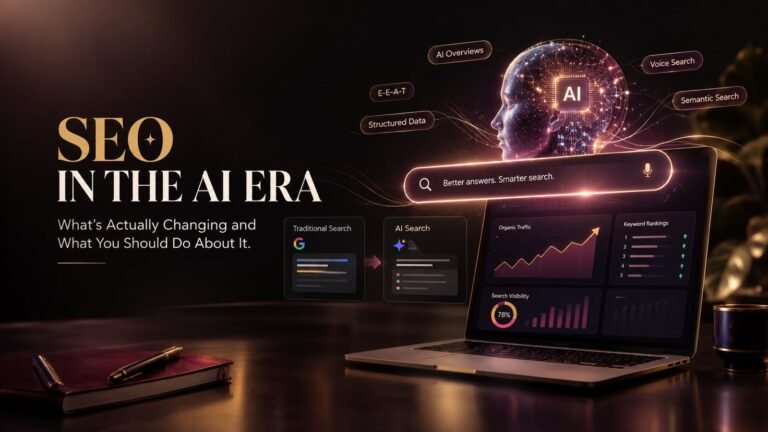
If you’ve been doing SEO for a while, you probably remember when stuffing keywords into a page was enough to rank. Then Google got smarter. Then mobile happened. Then voice search. And now, here we are — artificial intelligence is reshaping how people search, how search engines work, and what it means to “rank” in the first place.
Honestly, the first time I saw an AI-generated answer sitting at the very top of a Google search results page, taking up half the screen before any organic results, I felt a mix of panic and curiosity. I thought, “Is everything I know about SEO about to become useless?”
The short answer is no. But the longer answer is more interesting — and that’s what this post is about.
.
What Is Actually Happening With Search Right Now
If you’ve been doing SEO for a while, you probably remember when stuffing keywords into a page was enough to rank. Then Google got smarter. Then mobile happened. Then voice search. And now, here we are — artificial intelligence is reshaping how people search, how search engines work, and what it means to “rank” in the first place.
Honestly, the first time I saw an AI-generated answer sitting at the very top of a Google search results page, taking up half the screen before any organic results, I felt a mix of panic and curiosity. I thought, “Is everything I know about SEO about to become useless?”
The short answer is no. But the longer answer is more interesting — and that’s what this post is about.
.
How AI Is Changing the Way Search Engines Work
Search Engines Are Now Better at Understanding Meaning
Old-school SEO was largely about matching keywords. If someone searched “best running shoes,” you’d put “best running shoes” in your title, your headers, and your body copy — as many times as you could reasonably justify.
Search engines have been moving away from that model for years, but AI has pushed it much further. Google now uses large language models to understand what a query actually means, not just what words were typed.
For example, if someone searches “my feet hurt after running,” Google understands they’re probably looking for causes, solutions, and maybe shoe recommendations — not just pages that contain those exact words.
This means:
* Content that genuinely answers questions does better than content that just targets keywords
* Context and related topics matter more than keyword repetition
* Understanding user intent — what they actually want, not just what they typed — is now the foundation of good SEO
AI Overviews Are Taking Up More Real Estate
Google’s AI Overviews appear at the top of many search results pages, pulling together answers from multiple sources. These summaries can answer a user’s question without them ever visiting a website.
This is frustrating, especially if you’ve spent months building a page that ranks #1 but now sits below an AI-generated block of text.
However — and this is important — getting cited in AI Overviews can actually drive brand awareness and some traffic. If Google’s AI is pulling your content to answer questions, you’re still being surfaced, even if the click doesn’t always come.
The goal is shifting from “rank on page one” to “be the source that AI trusts.”
People Are Using AI Tools as Search Engines

This is the part that keeps SEO professionals up at night.
When someone asks ChatGPT “what’s the best project management tool for a small team,” they’re not searching Google. They’re not seeing your carefully optimized page. They’re getting a synthesized answer based on what the AI was trained on, plus (in some versions) real-time web data.
Perplexity works similarly, often pulling from multiple sources and citing them — which means there’s a new kind of “ranking” happening: being a source that these AI tools trust and reference.
What SEO Still Gets Right (and Why It's Not Dead)
Before we go further, let me say something plainly: SEO is not dead.
People still search. Websites still rank. Clicks still happen. But the game has changed enough that old tactics won’t cut it anymore.
Here’s what still works — and why:
High-Quality Content Is More Important Than Ever
AI-generated content is everywhere now. It’s fast and cheap to produce, which means the internet is getting flooded with average, generic, surface-level articles.
The opportunity here is to do the opposite.
Content that is:
* Based on real experience or genuine expertise
* Specific and detailed rather than vague and broad
* Genuinely helpful in a way that solves a real problem
…is becoming rarer and more valuable. Google has explicitly said it wants to reward “people-first content” — content written for humans, not for search engines.
E-E-A-T Is Now Central to Everything
In the AI era, this matters more, not less. Here’s why:
* *Experience* means content written by someone who has actually done the thing they’re writing about. A review of a product written by someone who used it will always outperform a generic summary.
* *Expertise* means demonstrating real knowledge in a field, not just surface-level coverage.
* *Authoritativeness* is about your site’s reputation in your niche — who links to you, who mentions you, how well-known you are.
* *Trustworthiness* means your site is accurate, transparent, and safe for users.
These are qualities that are genuinely hard to fake, even with AI. A faceless website pumping out AI-generated content can’t easily establish real E-E-A-T.
Technical SEO Still Matters
No matter how smart search engines get, they still need to crawl and index your website. Technical SEO — making sure your site is fast, mobile-friendly, well-structured, and easy for search engines to read — still forms the foundation of everything else.
Things like:
* Page speed and Core Web Vitals
* Clean URL structures
* Proper use of schema markup
* Fixing broken links and crawl errors
These aren’t glamorous, but they’re still necessary. A great piece of content buried on a slow, poorly structured website won’t perform well.
What Needs to Change in Your SEO Approach
The way I used to think about SEO content was: pick a keyword, write an article targeting that keyword, move on to the next keyword.
That model still has a place, but it’s too narrow now.
A better approach is to think in terms of topics and subtopics. If you run a website about personal finance, it’s not enough to write one article on “how to save money.” You need to build out a full topic cluster — covering budgeting, savings accounts, emergency funds, spending habits, financial goals — that together signals to Google that your site is a genuine authority on the topic.
This approach:
* Helps you capture a wide range of related searches
* Builds topical authority, which AI-era search engines reward
* Creates natural internal linking opportunities between related content
Focus on Being a Source Worth Citing
Since AI tools are now pulling information from trusted sources, your job is to become one of those sources.
What makes a source worth citing?
* Original data, research, or findings
* Clear expert authorship
* Accurate, well-cited information
* Content that goes deeper than what’s already out there
If your content is just summarizing what everyone else has already said, there’s no reason for an AI to specifically reference you. But if you’ve published original research, a unique case study, or a genuinely fresh perspective — that’s something worth referencing
Build Your Brand, Not Just Your Rankings
Here’s a shift I’ve noticed: branded search is becoming more valuable.
When someone already knows your name and searches for it directly — or searches “your brand + topic” — you’re not competing with AI Overviews in the same way. You’re getting direct, intentional traffic.
This means investing in:
* Building a recognizable name in your niche
* Creating content that people remember and share
* Getting mentioned on podcasts, in newsletters, on social media
* Encouraging people to seek you out specifically
Brand-building and SEO used to feel like separate things. In the AI era, they’re increasingly connected.